Compressed Sofa vs Traditional Sofa: The Complete Guide for Furniture Importers and Wholesale Buyers
If you are a furniture importer, wholesaler, or B2B buyer sourcing sofas for international markets, the choice between compressed sofas and traditional sofas has a direct impact on your logistics costs, warehouse efficiency, and profit margins.
This guide breaks down everything you need to know — from container loading rates and ocean freight costs to supplier selection criteria and foam quality standards — so you can make a smarter sourcing decision.
What Is a Compressed Sofa? (And Why Importers Are Switching)
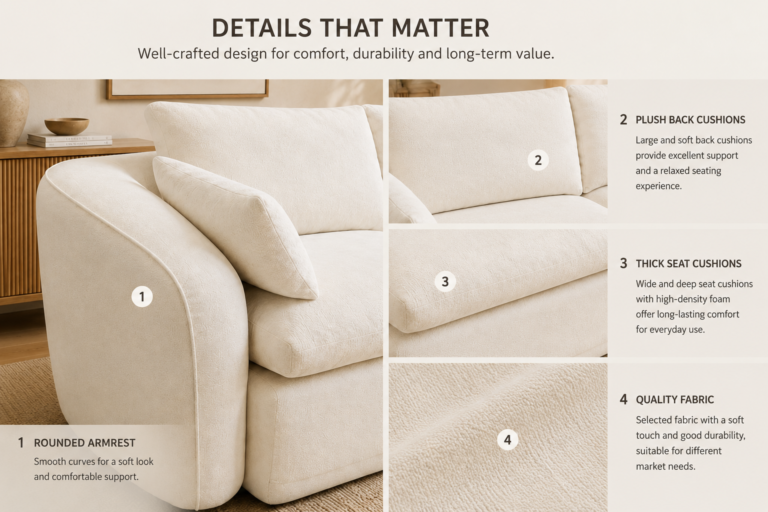
A compressed sofa is manufactured using high-resilience foam that can be vacuum compressed and rolled or folded into a compact carton. After delivery, the sofa expands back to its full shape within a few hours.
For furniture importers and wholesale buyers, the key advantage is not just the product — it is the shipping efficiency. Compressed sofas allow significantly more units per container load, directly reducing your ocean freight cost per unit.
What Is a Traditional Sofa?
Traditional sofas are built around rigid wooden or metal frames combined with spring systems. Because of this fixed structure, they cannot be compressed or rolled during shipping.
This means:
- Large packaging volume per unit
- Lower container loading efficiency
- Higher freight cost per piece
- More complex last-mile delivery logistics
Traditional sofas remain preferred in luxury showroom retail and high-end custom furniture markets, but they are increasingly difficult to manage in cost-sensitive import and wholesale operations.
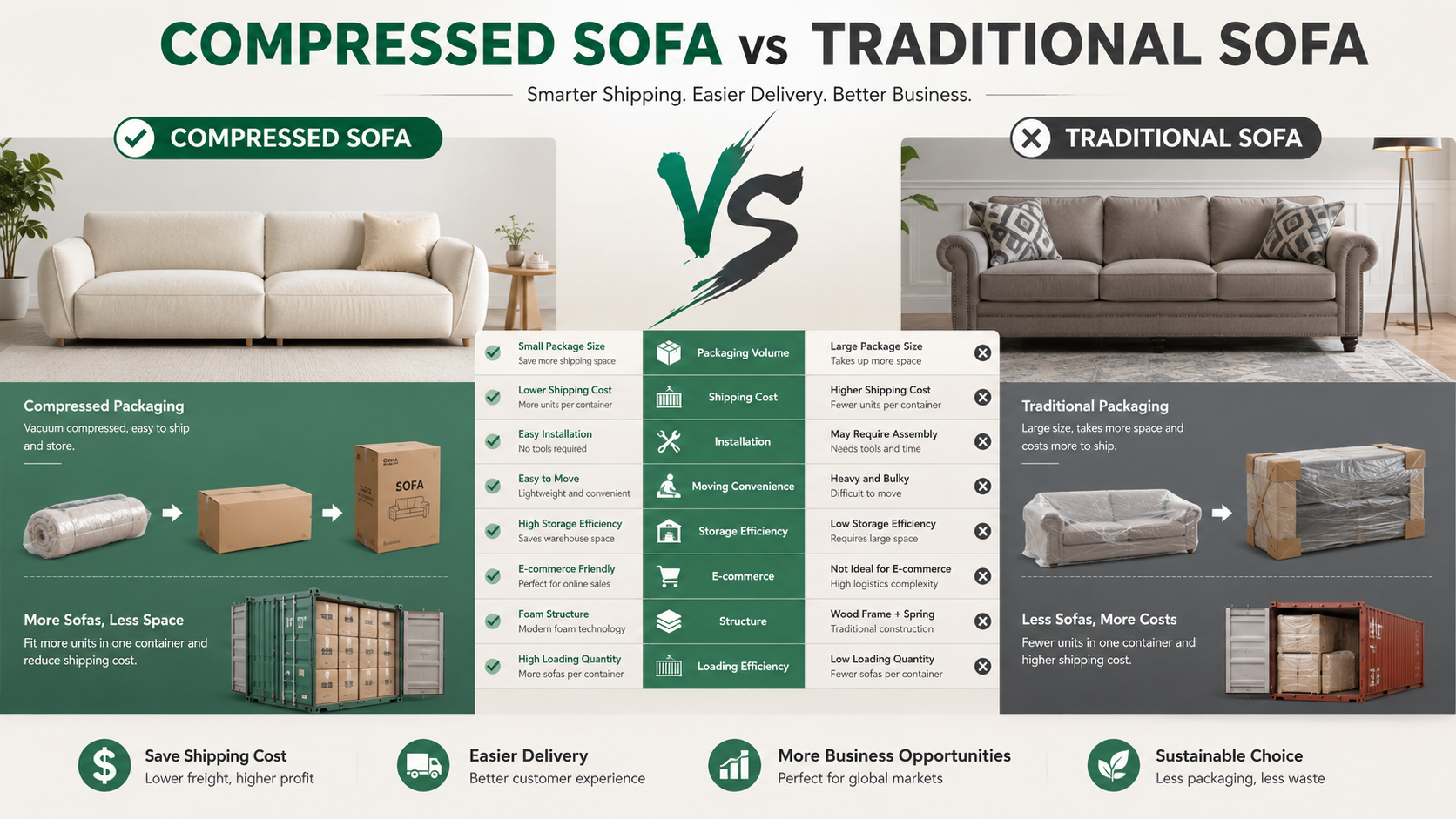
Compressed Sofa vs Traditional Sofa: Full Comparison
| Feature | Compressed Sofa | Traditional Sofa |
|---|---|---|
| Shipping Volume (CBM) | Very low | High |
| Container Loading Efficiency | High — more units per FCL | Low loading quantity |
| Ocean Freight Cost Per Unit | Lower | Higher |
| Warehouse Storage Requirement | Space-saving | Requires larger floor space |
| MOQ Flexibility | Higher flexibility | Often limited by volume |
| E-Commerce Compatibility | Excellent | Difficult |
| Last-Mile Delivery | Easy home delivery | Bulky, harder to handle |
| Assembly Required | Usually none | May require tools |
| Structure | High-density foam core | Wood frame + spring system |
| Customs Clearance Volume | Lower declared volume | Higher declared volume |
Why Furniture Importers Are Switching to Compressed Sofas
1. Lower Ocean Freight Cost Per Unit
Container loading efficiency is one of the most important cost variables in furniture importing.
With compressed sofas:
- More units fit inside a single FCL (full container load)
- Ocean freight cost per piece drops significantly
- Warehouse receiving costs decrease
- Local delivery costs are easier to manage
For importers and wholesalers running tight margins, this logistics saving directly improves profitability per order.
2. How to Calculate Container Loading Efficiency
Before placing a bulk order, ask your supplier for the exact carton CBM (cubic meters) per unit.
A basic calculation:
- Standard 20ft container internal volume: approximately 25–26 CBM
- Standard 40ft container internal volume: approximately 55–58 CBM
- Divide container volume by carton CBM to estimate maximum loading quantity
For example, if a compressed sofa carton is 0.25 CBM, a 40ft container can hold approximately 220 units. A traditional sofa at 0.9 CBM per unit would only load around 60 units in the same container — nearly four times the freight cost per piece.
Always request the exact packing specification (L × W × H in cm, gross weight in kg) from your supplier before calculating.
3. Ideal for Cross-Border E-Commerce and B2B Wholesale Channels
Traditional sofas were designed for showroom retail. Compressed sofas are built for modern supply chains, including:
- Cross-border furniture e-commerce platforms
- Amazon furniture wholesale programs
- TikTok Shop furniture brands
- Direct-to-consumer furniture businesses
- Regional furniture wholesale distributors
Smaller packaging simplifies both fulfillment and home delivery, reducing damage rates and customer complaints during transit.
4. Easier Last-Mile Logistics
Compressed sofas offer significant advantages in final delivery:
- Fits standard elevator dimensions
- Easier to carry up stairs in apartment buildings
- Can be handled by one or two delivery staff
- Lower risk of damage during transit
For wholesale buyers supplying furniture retailers or online sellers, these delivery advantages translate into lower after-sales costs and better customer satisfaction.
Modern Foam Technology: What Importers Need to Know
Many buyers assume compressed sofas sacrifice comfort for convenience. This is no longer accurate.
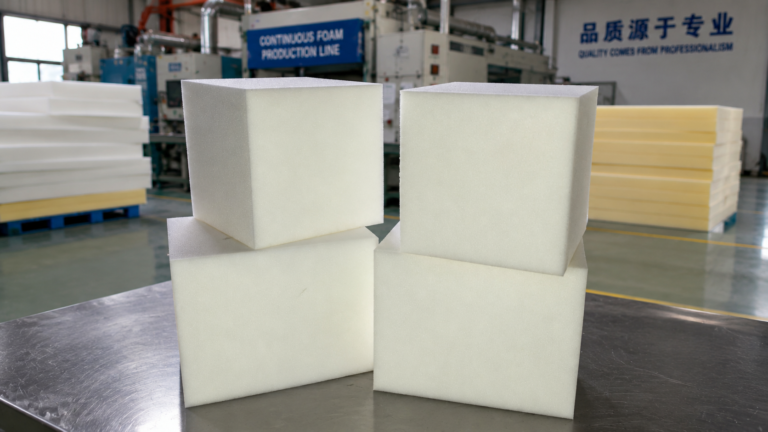
High-quality compressed sofas today use high-density, high-resilience foam that provides:
- Strong structural support
- Fast and consistent shape recovery after unpacking
- Good long-term durability under regular use
- Comfortable seating performance comparable to many traditional sofa designs
However, foam quality varies significantly between manufacturers. This is the most important technical factor to evaluate when sourcing compressed sofas for import.
Key foam specifications to request from suppliers:
- Foam density: typically measured in kg/m³; higher density = better durability
- Foam resilience (rebound rate): indicates how quickly and fully the sofa recovers shape
- Compression recovery time: how long the sofa takes to fully expand after unpacking
- Product certification: CertiPUR-US, OEKO-TEX, or equivalent quality standards
Potential Limitations of Compressed Sofas for Bulk Buyers
Recovery Time After Unpacking
After unpacking, compressed sofas typically require 4–24 hours to fully expand. For high-volume retail operations, this affects warehouse receiving workflows. Plan accordingly.
Foam Quality Risk
Low-quality foam sourced from lower-tier manufacturers may result in:
- Permanent shape deformation after several months
- Weak seat support
- Poor rebound performance
- Increased return and refund rates
This is why supplier qualification and product testing are critical steps before committing to a bulk import order.
Premium Positioning Limitations
Luxury furniture markets and high-end interior design clients still associate compressed sofas with mid-range product positioning. If your target market is premium retail, evaluate whether compressed sofas align with your brand positioning.
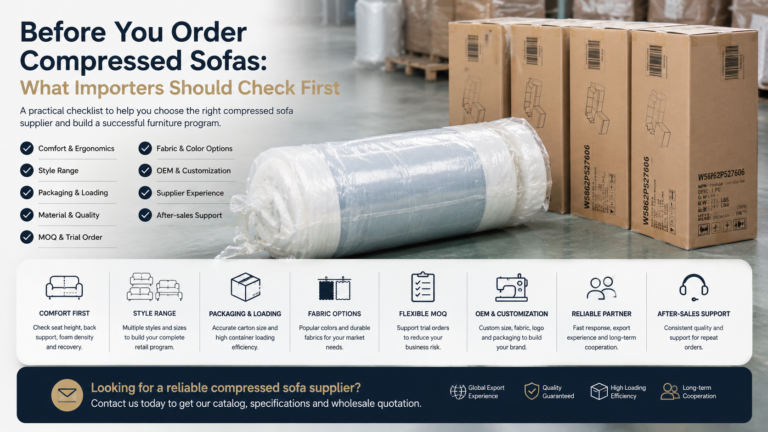
What to Ask a Compressed Sofa Supplier Before Placing a Bulk Order
Before finalizing any import order, request the following from your supplier:
- Product sample — evaluate foam density, rebound quality, and fabric finish in person or through a third-party inspection
- Packing specification sheet — carton dimensions (cm), CBM per unit, gross weight per carton
- Foam density and resilience test report — third-party lab testing is preferred
- MOQ (minimum order quantity) — confirm the minimum quantity per model or per container
- Lead time — production lead time from order confirmation to container loading
- OEM / ODM capabilities — fabric options, color customization, logo labeling
- Export documentation — certificate of origin, product compliance certifications, export packing list
- FOB or CIF pricing — clarify incoterms and included services before comparing quotes
Frequently Asked Questions from Furniture Importers
Q: What is the typical MOQ for compressed sofa bulk orders? MOQ varies by supplier and product model. Most manufacturers offer MOQ starting from one FCL (full container load), though some accept smaller trial orders at higher unit cost. Always confirm MOQ before requesting formal quotation.
Q: How long does a compressed sofa take to recover after unpacking? Most high-quality compressed sofas recover to their full shape within 4–12 hours at room temperature. Lower-quality foam may take longer or not fully recover.
Q: Can compressed sofas be customized for OEM orders? Yes. Most compressed sofa manufacturers offer OEM customization including fabric selection, color options, size adjustments, and private label packaging. Confirm minimum quantities for OEM orders separately from standard stock orders.
Q: What foam density should I specify for import quality standards? For commercial-grade import sofas, a foam density of 30–40 kg/m³ is generally acceptable for mid-range retail. Higher-end products may specify 40–50 kg/m³ or above. Always request a test report.
Q: Are compressed sofas compatible with Amazon FBA or similar fulfillment programs? Yes. Compact packaging dimensions make compressed sofas well-suited for Amazon FBA, third-party logistics warehouses, and direct-to-consumer fulfillment. Confirm exact carton dimensions meet warehouse receiving requirements before shipping.
Which Sofa Is Right for Your Business?
Choose Traditional Sofas If:
- Your market is luxury showroom retail or high-end interior design
- Your customers expect solid wood frame construction
- Logistics cost is not a primary constraint
Choose Compressed Sofas If:
- You are an active furniture importer or wholesale distributor
- You sell through e-commerce, Amazon, or cross-border channels
- Container loading efficiency and freight cost per unit matter
- You serve apartment markets or urban customers with delivery challenges
- You require OEM customization and flexible MOQ
Looking for a Reliable Compressed Sofa Manufacturer for Bulk Orders and OEM?
At Nestory Sofa, we specialize in compressed sofa solutions for global furniture importers, wholesale distributors, and online furniture brands.
We offer:
- OEM and ODM customization — fabric, color, size, and private label options
- Bulk import orders — competitive FOB pricing with flexible MOQ
- Vacuum compressed packaging — engineered for maximum container loading efficiency
- High-resilience foam — density specifications available with third-party test reports
- Export support — full documentation including certificate of origin, packing list, and compliance certificates for international markets
Contact us for product catalogs, packing specifications, and EXW quotations.