Compressed Sofa Comfort Standards: What Importers Should Specify Before Ordering
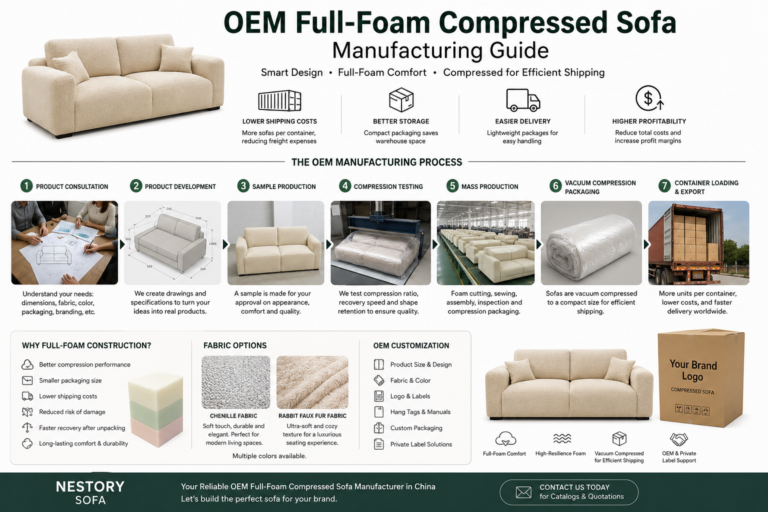
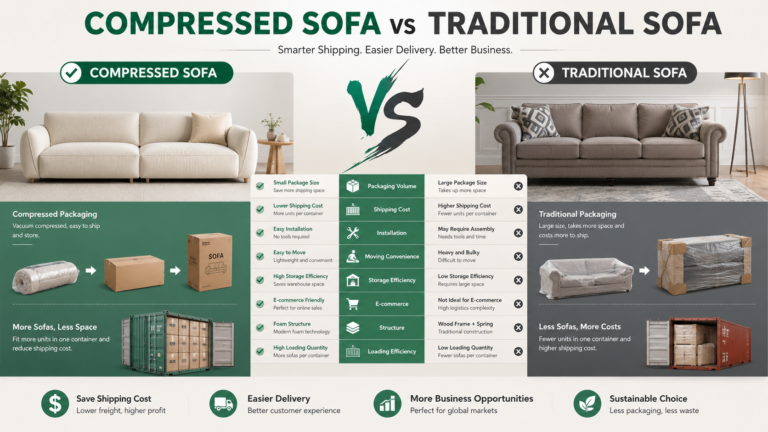
Compressed sofas can solve several practical problems for furniture importers. They reduce shipping volume, use less warehouse space, simplify parcel delivery, and allow retailers to offer large upholstered furniture without bulky traditional packaging.
But logistics efficiency is only one part of the product.
A compressed sofa may recover well after unpacking and still perform poorly in the market if the seat is too high, the back is too low, or the seat and back feel inconsistent.
For importers, comfort should not be treated as a subjective detail that can be checked after production. It should be defined as part of the product specification before the order is confirmed.
A Small Carton Does Not Guarantee a Good Sofa
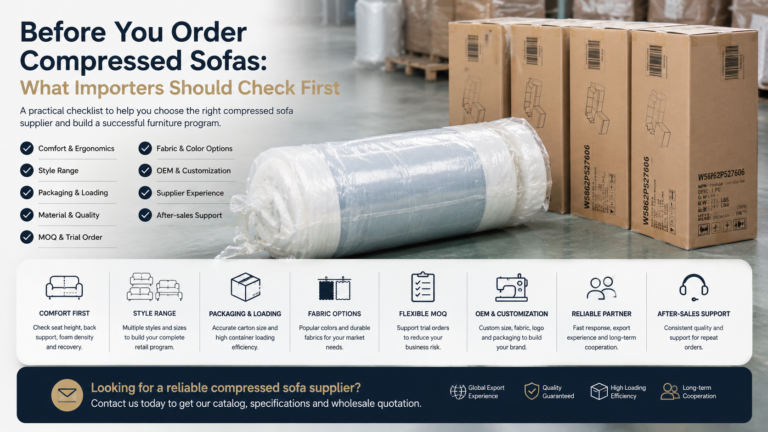
When buyers compare compressed sofas, they often focus first on:
- Unit price
- Compressed carton size
- Container loading quantity
- Recovery time
- Fabric and color
- Production lead time
These factors are important, but none of them confirms whether the sofa will be comfortable in everyday use.
- The seat feels too high.
- The seat is too deep for shorter users.
- The back cushion has insufficient support.
- The seat is firm while the back is too soft.
- The sofa looks full in photos but collapses during use.
- Different modules in the same collection feel inconsistent.
These problems are usually not caused by compression alone. They are more often related to product dimensions, foam selection, cushion structure, and inadequate sample testing.
Start With the Target Customer
There is no universal comfort standard that works for every customer and every country.
A sofa designed for relaxed apartment living may need a lower seat and deeper sitting area. A product intended for families, older users, rental properties, or commercial environments may require a more upright position and firmer support.
Before selecting a sofa model, importers should clarify:
- Target country or region
- Main customer age group
- Typical user height
- Retail price range
- Online or offline sales channel
- Residential or commercial use
- Preferred seating style
- Expected daily usage
Without this information, a supplier can only recommend a general product rather than a sofa developed for the intended market.
1. Finished Seat Height
Seat height influences posture, leg support, and how easily a user can sit down or stand up.
If the seat is too high, shorter users may not be able to place their feet comfortably on the floor. This can create pressure under the thighs. If the seat is too low, the sofa may feel relaxed, but some customers may find it difficult to stand up.
Importers should confirm more than the height shown on a product drawing. The final seating position is also affected by:
- Foam firmness
- Cushion thickness
- Upholstery tension
- User weight
- The amount of sinking during use
A sofa with a moderate measured height may still feel high if the seat is very firm. A lower sofa may feel even lower if the foam compresses too easily.
The specification should include:
- Unloaded seat height
- Seat height under normal sitting pressure
- Cushion thickness
- Expected sinking depth
- Intended seating position
2. Usable Seat Depth
Overall sofa depth and usable seat depth are different measurements.
Usable seat depth refers to the actual space available after the back cushion is placed in its normal position. This measurement has a major effect on comfort.
A shallow seat may support upright sitting but feel restrictive for lounging. A very deep seat may look luxurious in product photography, but shorter users may be unable to lean against the back while keeping their feet on the floor.
For deep-seat models, additional lumbar cushions may be necessary.
Importers should confirm:
- Total sofa depth
- Usable seat depth
- Back cushion thickness
- Cushion movement during use
- Whether lumbar cushions are included
- Whether the model is designed for upright sitting or lounging
Seat depth should also remain consistent across related models. A single-seater and a three-seater should not feel like completely different products simply because their external sizes are different.
3. Effective Back Support
One of the most common problems in compressed sofas is insufficient back support.
Some models use large, soft back cushions to create a full appearance. However, once the customer leans back, the cushion may collapse too far or move out of position. A low internal back may also fail to hold the cushion properly.
Importers should not judge support only by the total sofa height. They should check:
- Height from the compressed seat surface to the top of the back cushion
- Internal back height
- Back angle
- Back cushion thickness
- Back cushion firmness
- Cushion movement under pressure
- Support position on the user’s body
A sofa may look high enough from the outside while providing support only to the lower back. The correct standard depends on whether the product is designed to support the waist, mid-back, shoulders, or head.
4. Balance Between the Seat and Back
Comfort is not simply a choice between soft and firm.
Many sofas feel uncomfortable because the seat and back do not work together.
- A firm seat with an excessively soft back
- A soft seat with a flat and unsupported back cushion
- A seat that sinks deeply while the back remains upright
- A comfortable centre seat with firmer edge positions
- A thick-looking back cushion that offers little resistance
In these cases, the seat and back may feel as though they were developed for different products.
Importers should define the intended seating feel more clearly, for example:
- Soft lounge comfort
- Medium-soft residential comfort
- Balanced medium support
- Firmer support for commercial use
5. Foam Density Is Not the Complete Specification
Foam density is important, but it should not be used as the only indicator of quality or comfort.
Two foams with the same density can have different firmness, resilience, cell structure, and recovery performance.
Comfort also depends on:
- Foam hardness
- Foam thickness
- Number of foam layers
- Shape of each component
- Upholstery tension
- Seat dimensions
- User weight
- Compression duration
- Recovery performance
Nestory’s main compressed sofa projects use 32D high-resilience foam, but the final result still depends on how the foam is arranged inside the sofa.
A seat may require a firmer support layer with a softer comfort layer above it. A back cushion may need a different structure because it carries pressure differently.
Importers should ask for:
- Foam density
- Firmness or hardness range
- Layer thickness
- Layer arrangement
- Foam type used in the seat
- Foam type used in the back
- Foam type used in the arms and edges
The internal structure should match the intended seating feel, not simply the lowest possible compressed volume.
6. Comfort After Compression Recovery
A compressed sofa should not be fully evaluated immediately after unpacking.
Vacuum compression places temporary pressure on the foam, fabric, seams, and cushions. The product needs time to recover.
Recovery may be affected by:
- Compression duration
- Storage time
- Room temperature
- Foam resilience
- Fabric tension
- Product thickness
- Packaging method
During sample evaluation, importers should check:
- Final expanded dimensions
- Seat and back height
- Left-to-right symmetry
- Cushion fullness
- Edge recovery
- Fabric wrinkles
- Firmness consistency
- Recovery after repeated sitting
An unboxing video can show that the product expands, but it does not prove that the sofa has reached its final dimensions or final seating feel.
The sample should be tested only after the recommended recovery period.
7. Every Seating Position Should Be Tested
Large sofas and sectional models do not always feel the same in every position.
The centre seat, arm-side seat, corner unit, and chaise may use different foam shapes or dimensions.
Importers should test:
- Left-side seat
- Centre seat
- Right-side seat
- Corner module
- Chaise section
- Armrest
- Connection points between modules
This is especially important for modular sofas. A product may look consistent when assembled, but customers will notice immediately if one module feels softer, lower, or less supportive than another.
8. Test the Sofa for Longer Than One Minute
A quick sit-down test is not enough.
A sofa with a soft surface may feel comfortable during the first minute. After 15 or 30 minutes, the user may notice weak lumbar support, excessive sinking, pressure under the legs, difficulty changing position, inconsistent support between seats, or slow foam recovery.
A more useful sample test should include:
- Sitting upright.
- Leaning back naturally.
- Sitting continuously for 15 to 30 minutes.
- Testing relaxed and upright positions.
- Standing up and checking recovery.
- Repeating the test on every seat.
- Collecting feedback from several users.
Where possible, the test group should include people with different heights and body weights. One person’s opinion is not enough to define a market standard.
9. Comfort Must Be Consistent Across the Collection
One successful sofa model is not enough to build a complete retail program.
Importers may need:
- Single-seaters
- Loveseats
- Three-seaters
- Chaise sofas
- L-shaped sectionals
- U-shaped sectionals
- Modular combinations
The products may share the same fabric and design language while offering very different seating experiences.
This often happens when models are developed independently or when an existing design is resized without adjusting the internal structure.
- A single-seater may become too narrow after the arm width is retained.
- A loveseat may use the same back cushion as a larger model.
- A corner module may feel firmer because of its shape.
- A chaise may sink more deeply than the standard seat.
- Seat height may vary between modules after recovery.
The collection should be reviewed for seat height, usable seat depth, back support, seat firmness, back firmness, arm height, visual proportions, and modular connection height.
A retailer is not only buying individual sofas. The retailer is building a product line that customers expect to feel consistent.
10. Approve a Golden Sample Before Mass Production
Once the sample has been tested and accepted, it should become the Golden Sample for mass production.
The Golden Sample should confirm:
- Overall dimensions
- Seat height
- Seat depth
- Back height
- Foam density
- Foam firmness
- Layered construction
- Fabric type and color
- Cushion shape
- Stitching details
- Seating feel
- Compressed carton size
- Recovery time
- Expanded appearance
Written specifications are necessary, but they cannot fully describe seating comfort.
The Golden Sample gives the importer and manufacturer a physical reference for production and inspection. Without an approved reference, terms such as “medium soft” or “comfortable support” can be interpreted differently by different people.
Questions Importers Should Ask Before Ordering
- Who is the target user for this model?
- Is the product designed for upright sitting or lounging?
- What is the finished seat height after recovery?
- What is the usable seat depth?
- Where does the back cushion support the body?
- What foam density and firmness are used?
- How many foam layers are used in the seat?
- Is the back structure different from the seat structure?
- Does every module follow the same comfort standard?
- How long should the product recover after unpacking?
- How is firmness consistency checked during production?
- Can the approved sample be retained as the production standard?
A reliable supplier should be able to discuss these questions clearly—not only provide a quotation and container quantity.
Comfort Is a Commercial Issue
Comfort is not only a design preference. It directly affects commercial performance.
The logistics advantages of compressed sofas are real. They can reduce shipping volume, simplify warehousing, and support e-commerce delivery.
But those benefits only create lasting value when customers are satisfied after the sofa has been unpacked and used.
A successful compressed sofa program needs more than a compact carton. It needs a clearly defined target customer, verified dimensions, balanced seat and back support, tested foam construction, consistent comfort across the collection, and an approved Golden Sample.
That is how importers reduce risk before mass production—and build products that customers are willing to keep, review, and recommend.
Planning a Compressed Sofa Program?
Share your target market, preferred seating feel, required dimensions, product configurations, sales channel, and estimated order quantity. Nestory can help evaluate suitable full-foam compressed sofa models, upholstery options, carton dimensions, customization requirements, and estimated 40HQ loading quantities.