Importer’s Guide · Compressed Sofas
Compressed Sofa Buying Guide for Importers
Eight critical checks to make before you order—from comfort recovery and ergonomics to packaging data, OEM capability, and supplier reliability.
Compressed sofas have become one of the fastest-growing product categories in furniture importing—and for good reason.
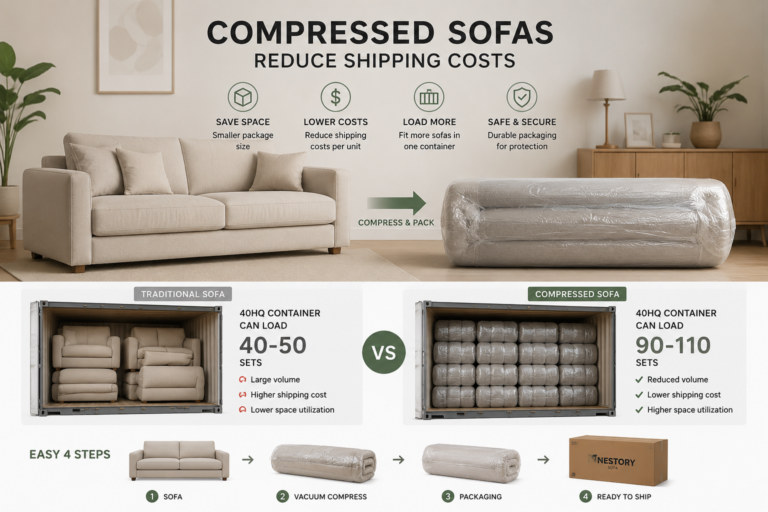
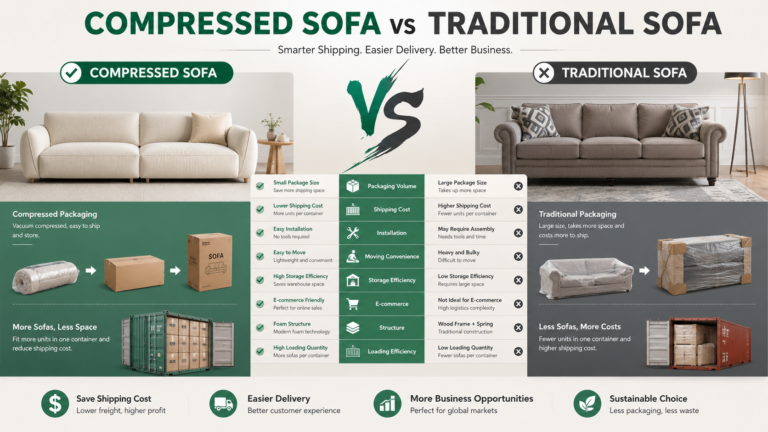
Compared with traditional frame sofas, compressed sofas can reduce shipping volume by 40–60%, dramatically improve 40HQ container utilization, cut warehousing costs, and streamline last-mile delivery for both e-commerce and retail channels. For importers managing tight margins and complex logistics, those advantages are impossible to ignore.
But here’s where many buyers go wrong.
They treat compressed sofas purely as a logistics solution and focus almost entirely on carton dimensions and container loading numbers. What they overlook—and what their retail customers or end consumers will notice immediately—is whether the sofa is actually comfortable, well-made, and sellable in their market.
A compressed sofa that ships efficiently but sits poorly will generate returns, damage reviews, and kill repeat business.
Before you place your next order, use this checklist to evaluate what really matters.
1 Verify Comfort After Full Recovery
Shipping efficiency is the starting point—not the finish line. The real test is how the sofa feels after it’s been unpacked, expanded, and placed in a living room.
Full-foam compressed sofas require time to fully recover their shape after decompression. During this window, and even after, structural issues can surface:
- The seat may feel harder or softer than expected
- The back cushion height may be insufficient for proper lumbar support
- The seat-to-back angle may feel off or create pressure points
- The foam may recover unevenly, leading to visible surface irregularities
For importers, these are not cosmetic issues—they directly affect product returns, online reviews, and whether retail buyers reorder.
Before committing to an order, request the following from your supplier:
- Seat height (floor to seat surface, fully recovered)
- Seat depth
- Back cushion height
- Foam density (kg/m³) and grade
- Estimated recovery time after unpacking
- Post-recovery product photos and video
- Detailed comfort specifications
A good supplier should be able to provide all of this. If they can’t, that’s a red flag.
2 Evaluate Seat Height and Back Support Specifications
Two ergonomic details that buyers consistently underestimate at the sourcing stage—and that retailers and end customers notice immediately.
Seat height affects who can comfortably use the sofa and how it fits in a room. A seat that’s too high creates an unrelaxed posture. Too low, and it becomes difficult for older users to stand up.
Back support determines daily comfort. A back cushion that’s too shallow, too low, or angled incorrectly will leave users with back discomfort after extended sitting—exactly the kind of feedback that shows up in 1-star reviews.
For compressed sofas specifically, these parameters are more critical than for traditional wood-frame sofas because the entire structural support system depends on foam engineering—density, layering, thickness, and shape—rather than a rigid frame beneath.
Importers should request:
- Front and side-view product photos (not just front-facing renders)
- Seating height and back cushion height measurements
- Foam structure breakdown (base support layer + comfort layer specifications)
- Use-scenario photos showing the sofa in a realistic room setting with people seated
3 Assess Whether the Supplier’s Range Can Support a Full Retail Program
One strong model is a good signal—but it’s rarely enough to build a retail business around.
Furniture retailers need collections, not single products. Their customers have different living situations, tastes, and budgets. A supplier with only one compressed sofa design limits your ability to offer range, fill retail planograms, or respond to different buyer segments.
Consider what your retail program actually needs:
- Compact sofas and loveseats for small apartments and studio buyers
- Standard 3-seaters for the mainstream family market
- Modular sofas for buyers who want flexibility
- L-shape sectionals for open-plan living rooms
- Large lounge sofas for premium or family-oriented segments
- Multiple fabric and color options to match local interior trends
A supplier with depth across these categories allows you to build a coherent product program—with entry, mid, and premium price points—rather than piecing together products from multiple vendors.
When evaluating a supplier’s range, also ask about new product development cadence. Are they releasing new compressed sofa designs regularly? Do they adapt their collection based on market feedback from international buyers?
4 Review Packaging and Container Loading Data in Detail
The logistics advantage of compressed sofas only materializes if the packaging data is accurate, well-engineered, and genuinely optimized for container loading.
Don’t accept vague claims like “high loading efficiency.” Request the actual numbers.
What to request from every supplier:
| Specification | Why It Matters |
|---|---|
| Compressed carton dimensions (L × W × H) | Container loading calculation |
| Expanded sofa dimensions | Confirms product size vs. listing |
| Gross weight / Net weight | Freight cost calculation |
| Quantity per 40HQ container | Directly affects landed cost per unit |
| Compression method | Roll-pack, vacuum-pack, or flat-pack |
| Recovery instructions | Affects the customer unboxing experience |
| Carton construction and edge protection | Prevents damage in transit |
Also verify whether carton dimensions are optimized for standard 40HQ container floor plans. Some manufacturers compress the sofa but use inefficient carton shapes that waste space. Ask for a container loading diagram if possible.
Packaging strength matters too. A sofa that arrives compressed but dented, torn, or with foam impressions from poor carton construction creates immediate customer problems.
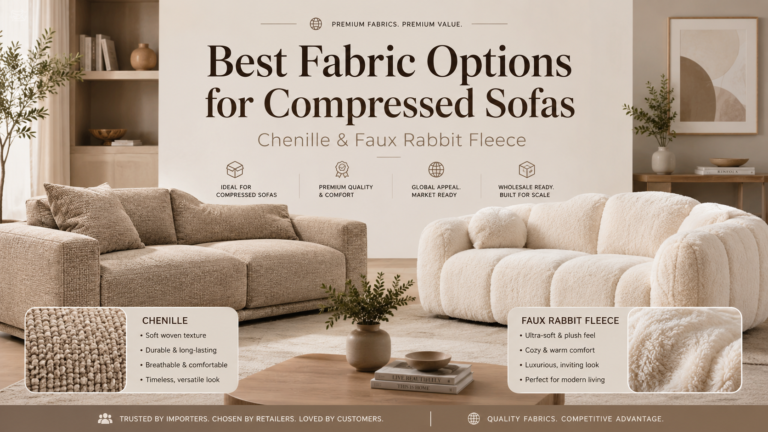
5 Evaluate Fabric and Color Suitability for Your Market
A well-engineered sofa with the wrong fabric choice for your target market will underperform regardless of its structural quality.
Fabric selection affects multiple dimensions of commercial success:
For e-commerce channels: The fabric must photograph well under standard lighting conditions. Texture, sheen, and color accuracy in photos are critical to click-through rates and conversion.
For physical retail: Customers make tactile decisions. A fabric that looks good online but feels rough or cheap in person will slow store sell-through.
For rental or project buyers: Durability and ease of cleaning often outweigh aesthetic preferences. Commercial-grade performance fabrics may be more appropriate.
Market-specific color guidance:
For buyers targeting Australia, the US, Canada, and most of Western Europe, neutral palettes—warm beige, soft grey, cream, caramel, and muted earth tones—align with contemporary interior design trends and have broad retail appeal. Trend colors can work for specific segments but carry higher markdown risk.
Key questions to ask your supplier:
- What fabric grades do you offer, and what are the abrasion ratings (Martindale cycles)?
- How consistent is color reproduction across production batches?
- Are fabric samples available before bulk order confirmation?
- Do you offer multiple colorways per model?
6 Clarify MOQ Requirements and Trial Order Policy
For importers entering a new product category or testing a new supplier, the first order is about risk management as much as it is about margin.
Before committing to a full container, you need to validate:
- How well the sofa recovers and presents after shipping
- How your target retail or e-commerce channel responds to the product
- Whether customer feedback aligns with specifications
- Whether the supplier’s production quality is consistent
A supplier who insists on large minimum orders for first-time buyers without any flexibility is creating unnecessary barriers to a long-term relationship. A supplier who understands how international importers build product programs will typically offer:
- Smaller trial quantities on selected models
- Sample shipments for retail photography and buyer presentations
- A clear path from trial to repeat order to volume commitment
Be clear with your supplier about your commercial roadmap. If your plan is to start small, validate, then scale—say so. The right supplier will work with that timeline.
7 Investigate OEM and Custom Development Capability
Standard catalog products are the starting point for many importers. But as your business grows, differentiation becomes increasingly important—and that requires a supplier who can execute custom development.
OEM and customization capabilities to evaluate:
- Custom dimensions—can the supplier adjust sofa size to meet specific market requirements?
- Custom fabric and color—can they work with your specified materials or develop new colorways?
- Private label packaging—can cartons, swing tags, and instruction manuals carry your brand?
- Product photography support—will they produce lifestyle or studio shots of your specific SKUs?
- Mixed container loading—can you combine multiple models in a single container?
- Market-specific collection development—will they help you build a range suited to your region’s taste and price points?
The distinction here is meaningful: a transactional supplier sells you products. A strategic supplier helps you build a product program. If you’re sourcing compressed sofas for serious retail or wholesale distribution, the latter is what you need.
8 Assess Supplier Communication and Export Experience
Compressed sofa orders involve significant coordination across specifications, production timelines, QC, packaging, loading, and documentation. Communication quality isn’t a soft factor—it’s a commercial risk variable.
Before signing off on an order, pay attention to how the supplier communicates during the inquiry and sample stage. It’s a strong predictor of how they’ll behave during production.
Signals of a reliable, export-experienced supplier:
- Provides clear, detailed product specifications without being prompted
- Sends organized packing lists with verified measurements
- Responds to inquiries within reasonable timeframes
- Can provide loading diagrams and container utilization data
- Has experience shipping to your region (customs, documentation, port requirements)
- Raises potential issues proactively rather than discovering problems after production
Signals to treat as warning flags:
- Vague or inconsistent product specifications
- Delayed responses during the inquiry stage
- Reluctance to provide samples before bulk commitment
- Inability to confirm container quantities with actual data
- No references or track record in your target market
If communication is slow or unclear before the order, it will almost certainly be slower and less clear once production begins and your leverage is reduced.
Summary: The Right Compressed Sofa Delivers on Both Logistics and Sales
Compressed sofas offer genuine competitive advantages for furniture importers—lower shipping costs, better container utilization, easier warehousing, and simpler last-mile delivery. These benefits are real, and they matter.
But logistics efficiency only creates value if the underlying product is good enough to sell.
A compressed sofa that ships efficiently but fails on comfort, appearance, or product range will cost you more in returns, lost repeat orders, and damaged retail relationships than you saved on freight.
Use this checklist before every order:
- Comfort after full recovery—seat height, back support, foam specifications
- Ergonomic specifications—side views, seating dimensions, foam layering
- Supplier range—enough variety to build a complete retail program
- Packaging data—verified carton dimensions, container quantities, carton strength
- Fabric and color—suited to your market channel and customer demographics
- MOQ and trial policy—room to test before scaling
- OEM capability—custom dimensions, fabric, private label, and collection development
- Supplier communication—export experience, responsiveness, and transparency
Work With a Compressed Sofa Supplier Built for Importers
Nestory Furniture specializes in compressed sofa collections designed for international wholesale, e-commerce, and retail distribution. Our range includes single sofas, loveseats, 3-seaters, modular configurations, and L-shape sectionals—with fabric options, OEM customization, and export packaging tailored to major markets including Australia, the US, Canada, and Europe.
We support importers with:
- Full product specifications and post-recovery photography
- Verified container loading data
- Trial order flexibility
- Private label and custom development programs
- Export documentation and logistics coordination