What Happens After Opening a Compressed Sofa?
Compressed sofas are becoming increasingly popular in modern furniture logistics because they help reduce shipping volume, lower transportation costs, and improve storage efficiency.
However, many buyers still ask the same question:
“What happens after opening a compressed sofa?”
Will the sofa recover properly?
Will the foam lose its shape?
How long does the rebound process take?
In this article, we explain what actually happens after unpacking a compressed sofa and why high-quality materials are essential for stable recovery performance.
The Sofa Starts Rebounding Immediately After Unpacking
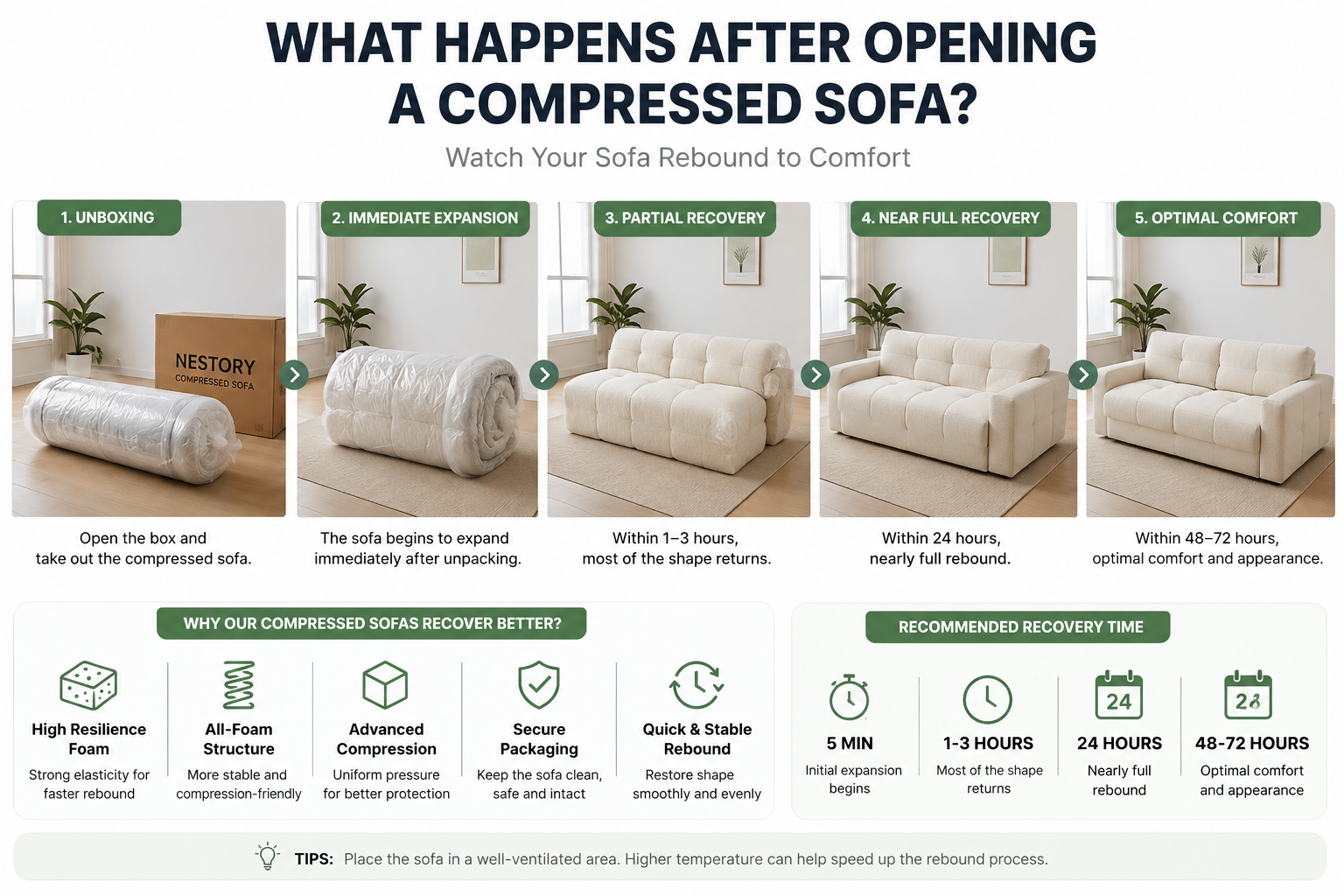
Once the vacuum packaging is removed, the compressed sofa begins to expand automatically.
This happens because the foam inside the sofa has been compressed under high pressure during packaging and transportation. After the air enters again, the foam structure gradually returns to its original shape.
For high resilience foam sofas, the rebound process usually begins within seconds.
How Long Does Full Recovery Take?
The rebound time depends on several factors:
Foam density
Compression duration
Temperature during transportation
Sofa structure
Packaging quality
In most cases:
| Time After Opening | Recovery Status |
|---|---|
| Within 5 minutes | Initial expansion begins |
| Within 1–3 hours | Most of the shape returns |
| Within 24 hours | Nearly full rebound |
| Within 48–72 hours | Optimal comfort and appearance |
High-quality compressed sofas typically recover faster and more evenly.
Why Foam Quality Matters
Not all compressed sofas perform the same after unpacking.
Low-quality foam may cause problems such as:
Slow rebound
Permanent deformation
Uneven seating
Surface wrinkles
Weak support
That is why foam selection is one of the most important factors in compressed sofa manufacturing.
At Nestory Sofa, we use high resilience foam designed specifically for compression applications.
This type of foam provides:
Better elasticity
Faster rebound speed
Stronger support
Higher durability
More stable shape recovery
The foam structure remains stable even after long-distance transportation and extended vacuum packaging.
Why All-Foam Structure Is Better for Compression
Traditional sofas with metal springs or wooden internal structures may face additional risks during compression:
Internal movement
Noise after recovery
Uneven rebound
Structural pressure points
All-foam sofas are more suitable for vacuum compression because the structure remains flexible and stable during the entire packaging process.
This helps improve:
Compression consistency
Packaging safety
Rebound performance
Long-term durability
Does Compression Damage the Sofa?
For properly designed compressed sofas, the answer is no.
Professional compressed sofas are developed specifically for vacuum packaging and international transportation.
The key factors include:
Suitable foam density
Stable compression technology
Proper packaging pressure
Controlled sealing process
When these factors are managed correctly, the sofa can maintain both comfort and appearance after unpacking.
What Buyers Should Pay Attention To
When sourcing compressed sofas, buyers should not focus only on appearance or price.
More importantly, they should evaluate:
Foam quality
Compression technology
Packaging stability
Rebound performance
Factory experience
A stable compression system can significantly reduce shipping risks and after-sales problems.
Final Thoughts
Compressed sofas are not simply “smaller sofas.”
The real value comes from combining:
High resilience foam
Stable compression technology
Reliable rebound performance
Efficient international shipping
A well-designed compressed sofa should arrive compact, recover smoothly, and maintain long-term comfort after unpacking.
That is why material quality and compression technology matter throughout the entire process.