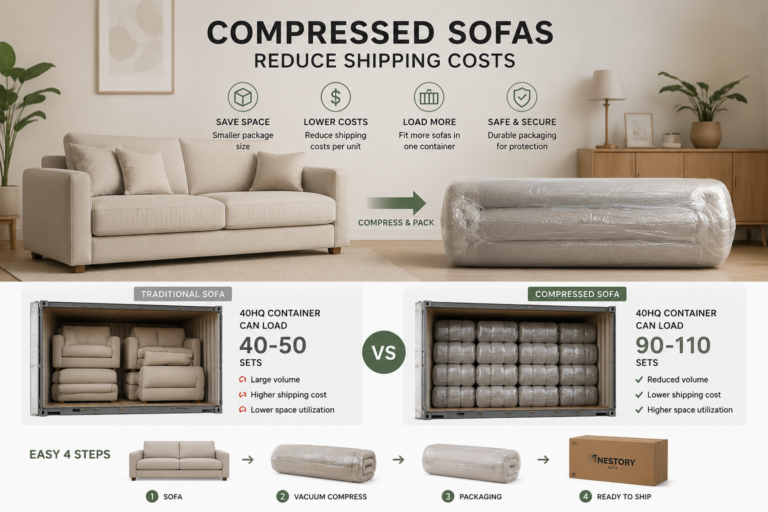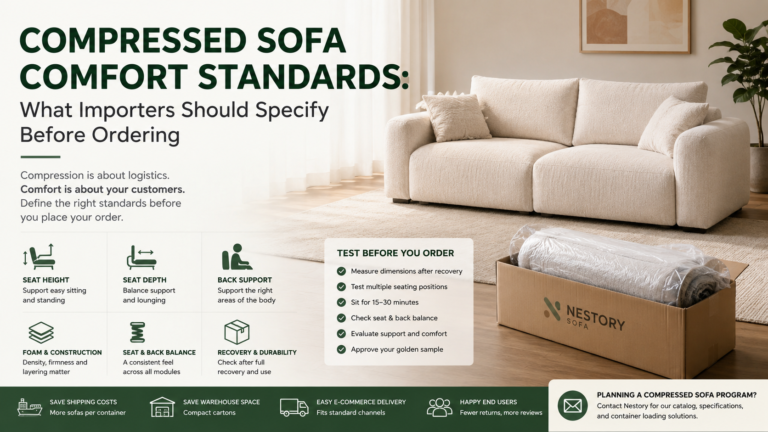
After approving a sample, importers still need to confirm two things: whether the production sofas meet the agreed dimensions, appearance and seating requirements after unpacking, and whether the actual packaging matches the carton specifications used to calculate freight costs.
Recovery deviations, differences between material batches and inaccurate packaging data can increase after-sales costs or affect the original shipping budget. A compressed sofa inspection should therefore turn purchasing requirements into results that can be checked.
The following six checks help buyers, suppliers and inspectors establish clear acceptance criteria.
1. Does the Production Order Have an Approved Sample and Specification?
Inspection starts with a reference agreed upon by both parties.
Alongside the approved physical sample, often called a golden sample, retain a dated specification sheet with a revision number. It should identify the model, fabric, configuration and any approved changes. For modular sofas, confirm which modules, accessories and cartons make up a complete set.
Before production, define:
- Recovered overall dimensions and key measurements, including seat height and seat depth;
- Foam layers, grades and thicknesses;
- Fabric, colour and main stitching requirements;
- Accessories, carton count and packaging method;
- Measurement methods, allowable deviations and appearance acceptance criteria.
These details help inspectors determine whether a difference falls outside the requirements and give suppliers a clear target for corrective action.
If the fabric, foam or packaging changes during production, record the change and the buyer’s approval so that final inspection follows the correct specification revision.
2. Does the Recovery Inspection Record Compression Duration and Observation Conditions?
An unpacking video can show the expansion process. To determine whether the product meets the requirements, the buyer also needs to know its compression and storage history.
For example, if the ordered sofas are expected to remain compressed for several weeks, a sample opened immediately after compression cannot fully represent that scenario. Arrange relevant testing early enough to allow time for evaluation and adjustments.
A recovery record should include at least:
- Model and identification of the tested unit;
- Compression and unpacking dates;
- Known storage conditions and room temperature at unpacking;
- Elapsed time between unpacking and each observation;
- Measurements, appearance photos and findings at each observation point.
Distinguish initial expansion from meeting the acceptance criteria. A cushion becoming larger does not establish that its dimensions, fullness and fabric appearance are all acceptable.
Agree on observation times and acceptance criteria for each model. Avoid applying one unverified recovery deadline to every product.
For an overview of what happens after unpacking, read our Compressed Sofa Unpacking and Recovery Guide. For a specific order, use the relevant model’s test records and agreed requirements as the acceptance basis.
3. Do Recovered Dimensions and the Complete Configuration Meet the Requirements?
After the agreed recovery period, place the sofa on a level surface and arrange the cushions in their approved positions before measuring.
Check overall width, depth and height, as well as unloaded seat height, usable seat depth and back support height. Use the same measurement methods applied to the approved sample and specification sheet.
Assemble modular sofas in the configuration specified in the order. Check:
- Whether adjoining modules have consistent seat heights;
- Whether gaps between modules exceed the agreed limits;
- Whether backrests, armrests and cushions align;
- Whether connectors and accessories fit correctly.
Even when individual modules pass inspection, the complete configuration still needs to be checked.
Use a consistent sitting evaluation method to compare the production sofa with the approved sample. If seating positions show noticeable differences in firmness or support, record their locations and investigate the corresponding materials and construction.
Sitting feedback can supplement dimension and appearance checks. Long-term durability requires relevant testing.
4. Do the Foam and Fabric Match the Approved Materials?
Material verification should relate to the configuration actually used in the order.
Foam density and firmness are different properties. High-density foam can be soft, and low-density foam can be firm, so density alone does not fully describe seating feel. Polyurethane Foam Association
Check the foam grades and thicknesses used in the seat, back and support layers. For firmness, resilience or other specified test results, confirm that reports correspond to the materials used and that the methods, units and sample conditions allow a meaningful comparison.
Supplier information, material identifiers and batch records help connect testing documents to the actual order.
For upholstery, compare the production fabric with the approved swatch under consistent lighting. Check colour, texture and pile direction where applicable, along with differences between adjoining modules, visible seams, stitching and zippers.
Make the final assessment of wrinkles and distortion after the agreed recovery period. When recording defects, retain both a wider photo showing the location and a close-up showing the detail.
If the purchasing requirements include abrasion resistance, pilling resistance, colourfastness or easy-clean performance, verify the supporting information for the selected fabric.
5. Does the Actual Packaging Match the Carton Specifications and Loading Plan?
Packaging inspection should cover both protection and data accuracy.
Check vacuum bags for punctures, damaged seals and visible loss of compression. Confirm that cartons, protective materials and closures match the approved packaging design. If seal retention checks have been agreed upon, record the observation interval and any changes in package dimensions.
Measure the external dimensions of the finished cartons and verify gross weights, carton counts and the packing list.
For a sofa set containing multiple cartons, include every carton in the volume calculation:
Carton volume (m3) = Length (cm) × Width (cm) × Height (cm) ÷ 1,000,000
Packaging volume per set = Combined volume of all cartons in that set
The carton specifications used for freight estimates should correspond to the actual shipment packaging. Omitting an accessory carton or using measurements that differ from the finished package can affect the budget.
Container loading quantities also depend on carton orientation, stacking limits, clearances and weight. Check the proposed loading plan against the actual packaging.
6. Have Inspection Deviations Been Resolved and Documented?
Before inspection, agree on sample selection, sample quantity and defect acceptance rules. The plan should cover the relevant models, fabrics and configurations in the order.
When a finding falls outside the requirements, the report should identify the affected products, the location and extent of the issue, and the corrective action taken. Follow-up results should correspond to the original finding so that the buyer can determine whether the shipment meets the release conditions.
Use the following table to organise the key records:
| Inspection area | Evidence to retain | Acceptance basis |
|---|---|---|
| Product configuration | Approved sample, specification revision and change approvals | Final configuration approved by both parties |
| Recovery | Compression duration, observation conditions and results at each time point | Agreed recovery criteria for the model |
| Dimensions and configuration | Measurements and complete assembly photos | Drawings, approved sample and allowable deviations |
| Foam and fabric | Material information, corresponding test documents and appearance records | Approved materials and performance requirements |
| Packaging | Seal records, measured carton dimensions, gross weights and carton counts | Packaging design and packing list |
| Corrective action | Issue scope, corrective measures and follow-up results | Agreed defect acceptance rules |
If inspection requires unpacking finished goods, agree in advance on how those units will be handled afterward. Products intended for shipment need their packaging restored and checked again, with the relevant records updated.
Final shipment approval should be traceable to the actual inspection findings and completed corrective actions.
Confirm Your Order Requirements with Nestory
If you are evaluating a compressed sofa wholesale or OEM project, please share your target market, preferred models or configurations, sales channel and estimated order quantity.
You can also provide any existing requirements for dimensions, fabrics or branded packaging.
Contact Nestory to discuss product specifications, packaging data and sample evaluation for your order, so that the quotation, sample approval and acceptance requirements follow the same agreed specifications.